The USA tourist visa (B1/B2) is a nonimmigrant visa that allows foreign nationals to temporarily visit the United States for tourism, business, or medical treatment. As of 2026, the application fee is $185, with an additional $250 Visa Integrity Fee bringing the total to $435 for most applicants. Citizens of 42 Visa Waiver Program countries may instead apply for an ESTA to visit the U.S. for up to 90 days without a visa.
What Is a USA Tourist Visa?
A USA tourist visa is a nonimmigrant visa stamped into your passport by a U.S. embassy or consulate abroad. It permits you to travel to a U.S. port of entry, where a Customs and Border Protection (CBP) officer makes the final decision on your admission and length of stay.
The most common tourist visa categories are:
- B-1 visa – for temporary business visitors attending meetings, conferences, or negotiating contracts
- B-2 visa – for tourists, vacationers, people visiting family, or those seeking medical treatment
- B-1/B-2 combined visa – the most commonly issued type, covering both business and tourism purposes
It is important to understand that a visa does not guarantee entry into the United States. It only authorizes you to travel to a U.S. port of entry and request permission to enter.
Who Needs a Tourist Visa to Visit the USA?
Most foreign nationals need a visa to enter the United States. However, there are notable exceptions:
- Canadian citizens do not need a visa for most short visits to the U.S.
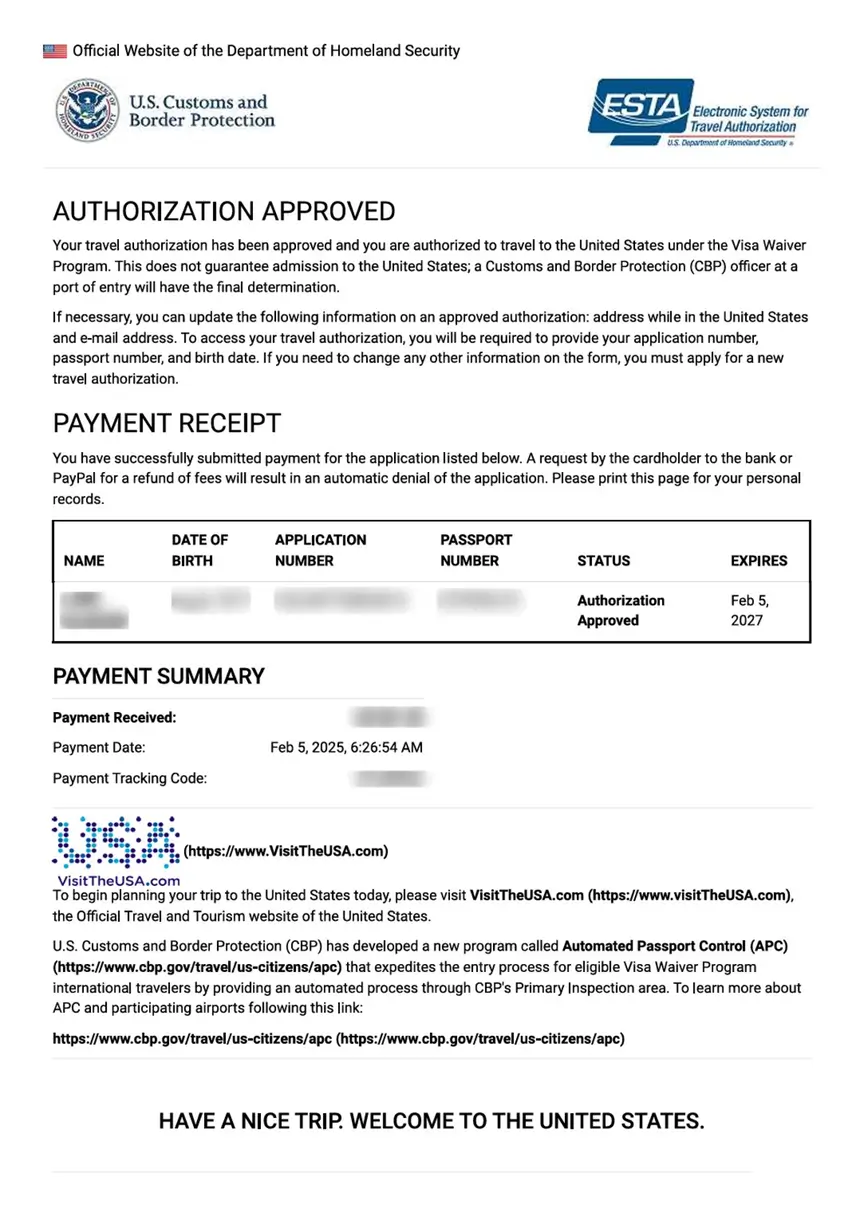
- Citizens of 42 Visa Waiver Program (VWP) countries – including the UK, Japan, Australia, South Korea, and most EU nations – can visit the U.S. for up to 90 days with just an ESTA authorization instead of a visa
- Bermuda, Bahamas, and certain Caribbean territory nationals may enter under special conditions without a visa
If you are not from a VWP country, Canada, or another exempt jurisdiction, you will need to apply for a B-1/B-2 tourist visa at a U.S. embassy or consulate.
Visa Waiver Program (ESTA) vs Tourist Visa
The key differences between ESTA and a tourist visa come down to eligibility, stay duration, and application process:
| Feature | ESTA | B1/B2 Tourist Visa |
|---|---|---|
| Eligibility | Citizens of 42 VWP countries only | All nationalities |
| Application | Online (15-20 minutes) | In-person interview at embassy |
| Fee | $40.27 | $435 ($185 + $250 Integrity Fee) |
| Max Stay | 90 days per visit | Up to 6 months per visit |
| Validity | 2 years or until passport expires | Up to 10 years (multiple entry) |
| Processing | Usually within 72 hours | Days to weeks (plus interview wait) |
| Renewal | Reapply online every 2 years | New application required when expired |
If you are from a VWP country and your visit is 90 days or less, an ESTA is almost always the better choice. For longer stays, work activities, or if you are from a non-VWP country, you will need a full tourist visa.
Types of US Visitor Visas
B-1 Visa (Business Visitor)
The B-1 visa is designed for people traveling to the U.S. for temporary business purposes, including:
- Attending business meetings, conferences, or conventions
- Consulting with business associates
- Negotiating contracts
- Attending short-term training
- Settling an estate
The B-1 visa does not permit you to work for a U.S. employer or receive payment from a U.S. source for labor.
B-2 Visa (Tourism and Pleasure)
The B-2 visa covers a wide range of non-business travel purposes:
- Tourism and sightseeing
- Visiting friends and family
- Medical treatment
- Attending social events hosted by fraternal, social, or service organizations
- Participating in amateur musical, sports, or similar events (without pay)
- Short recreational courses of study (not for credit toward a degree)
B-1/B-2 Combined Visa
Most U.S. embassies and consulates issue a combined B-1/B-2 visa. This gives you the flexibility to travel for either business or tourism on the same visa, which is especially convenient if your trip includes both purposes.
US Tourist Visa Requirements
To qualify for a B-1/B-2 tourist visa, you must demonstrate the following to a consular officer:
- Purpose of travel – You have a legitimate reason to visit the U.S. temporarily (tourism, business meeting, medical treatment, etc.)
- Ties to your home country – You have strong economic, family, and social ties that compel you to return home after your visit
- Financial capacity – You can fund your entire trip, including transportation, accommodation, and living expenses
- No intent to immigrate – You intend to leave the U.S. before your authorized stay expires
Required Documents
Prepare the following documents for your visa interview:
- Valid passport with at least 6 months validity beyond your planned stay in the U.S.
- DS-160 confirmation page (printed barcode from your online application)
- Visa application fee receipt ($185 MRV fee)
- Recent passport-style photograph meeting U.S. embassy specifications (51mm x 51mm, white background)
- Evidence of financial ability – bank statements, pay stubs, tax returns, or sponsor letter
- Proof of ties to home country – employment letter, property deeds, family documents, enrollment letter
- Travel itinerary – flight bookings, hotel reservations, day-by-day plans
- Invitation letter (if visiting family or attending an event) from your U.S. host
- Previous U.S. visa (if any) in your current or old passport
How to Apply for a US Tourist Visa (Step by Step)
The U.S. tourist visa application process follows these steps:
Step 1: Complete Form DS-160 Online. Go to the Consular Electronic Application Center (CEAC) website and fill out the DS-160 nonimmigrant visa application. The form takes approximately 60-90 minutes to complete. Save the confirmation page with the barcode – you will need it for your interview.
Step 2: Pay the Application Fee. Pay the $185 non-refundable MRV processing fee through the payment methods available in your country. Some countries require payment through a specific bank or online portal.
Step 3: Schedule Your Visa Interview. Create an account on the U.S. visa appointment website (ustraveldocs.com) and book your interview. Applicants aged 14-79 are generally required to attend an in-person interview. Wait times vary from a few days to several months depending on the embassy and season.
Step 4: Attend Your Visa Interview. Arrive at the U.S. embassy or consulate with all required documents. The consular officer will ask about your travel purpose, ties to your home country, and financial situation. Interviews typically last 3-5 minutes. Answer honestly and concisely.
Step 5: Receive Your Visa Decision. If approved, your passport will be returned with the visa stamp within a few days to a few weeks, depending on your location. If denied, you will be informed of the reason under section 214(b) of the Immigration and Nationality Act (most common) or other applicable grounds.
Step 6: Travel to the United States. With your visa, you can travel to a U.S. port of entry. Present your passport and visa to the CBP officer, who will determine your admission and how long you may stay (up to 6 months for B-1/B-2).
US Tourist Visa Fees in 2026
The cost of a U.S. tourist visa has increased significantly in 2026 due to the introduction of the Visa Integrity Fee. Here is the full breakdown:
| Fee Type | Amount | Notes |
|---|---|---|
| MRV Application Fee | $185 | Non-refundable, paid before interview scheduling |
| Visa Integrity Fee | $250 | New fee effective 2025, applies to most nonimmigrant visas |
| Total | $435 | Combined cost for B-1/B-2 visa |
| Reciprocity Fee | Varies | Additional fee for some nationalities based on reciprocal agreements |
The Visa Integrity Fee was introduced in 2025 as a $250 surcharge on most nonimmigrant visa categories. This fee is separate from the standard $185 MRV processing fee. However, citizens of some countries may have this fee waived or reduced based on bilateral agreements.
ESTA as a Lower-Cost Alternative
If you are from a Visa Waiver Program country, the ESTA costs only $40.27 ($21 processing fee + $19.27 authorization fee). This is dramatically less than the $435 tourist visa fee. Our guide to USA ESTA fees has a complete breakdown of how the ESTA charges work.
US Tourist Visa Processing Time
Processing times for a U.S. tourist visa depend on several factors:
- Interview scheduling wait: 3 days to 3+ months, depending on the embassy and time of year
- Administrative processing: If your case is selected for additional review, it can take 60+ days
- Passport return: 3-10 business days after approval in most locations
Peak travel seasons (summer, holidays) and major events like the 2026 FIFA World Cup can significantly extend wait times. Plan to apply at least 3 months before your planned travel date to avoid complications.
You can check current interview wait times at each U.S. embassy or consulate on the U.S. Department of State website.
How Long Can You Stay in the USA?
The length of your authorized stay is determined by a CBP officer at the U.S. port of entry, not by your visa itself:
- B-1/B-2 visa holders: Typically admitted for up to 6 months per entry. The exact duration is stamped on your Form I-94.
- ESTA holders: Admitted for a maximum of 90 days per visit, with no extensions allowed.
- Visa validity vs. stay: A 10-year visa does not mean you can stay for 10 years. It means you can use the visa to seek entry multiple times over 10 years. Each stay is limited to the period granted by the CBP officer.
Can You Extend Your Stay?
If you entered on a B-1/B-2 visa and need more time, you can apply to U.S. Citizenship and Immigration Services (USCIS) for an extension of stay using Form I-539. You must apply before your authorized stay expires. Extensions are granted in increments of up to 6 months. ESTA holders cannot extend their stay and must depart within 90 days.
B1/B2 Visa vs ESTA: Key Differences
Choosing between a B1/B2 visa and an ESTA depends on your nationality, trip length, and purpose of travel:
| Consideration | B1/B2 Visa | ESTA |
|---|---|---|
| Best for | Non-VWP citizens, long stays, repeated visits | VWP citizens, short visits up to 90 days |
| Cost | $435 total | $40.27 |
| Application time | Weeks to months | 15-20 minutes online |
| Interview required | Yes | No |
| Stay per visit | Up to 6 months | Maximum 90 days |
| Extensions | Possible via Form I-539 | Not allowed |
| Multiple entries | Yes (typically 10-year validity) | Yes (2-year validity) |
| Business activities | B-1 allows business meetings, conferences | Limited business activities only |
| Work authorization | No | No |
If you are from a VWP country like the UK, Germany, Japan, or Australia, and your trip is 90 days or less with tourism or basic business purposes, the ESTA is almost always the simpler and cheaper option. You can check the detailed ESTA requirements to see if you qualify.
For longer stays, countries not in the VWP, or more complex travel purposes, the B1/B2 tourist visa is the required path.